How a Class A infill development reached lease-up in this competitive secondary market
Urban infill multifamily projects often begin with sites that carry layers of history, infrastructure, and constraints that have to be understood before the building design can really take shape.
75 Canal is one of those projects.
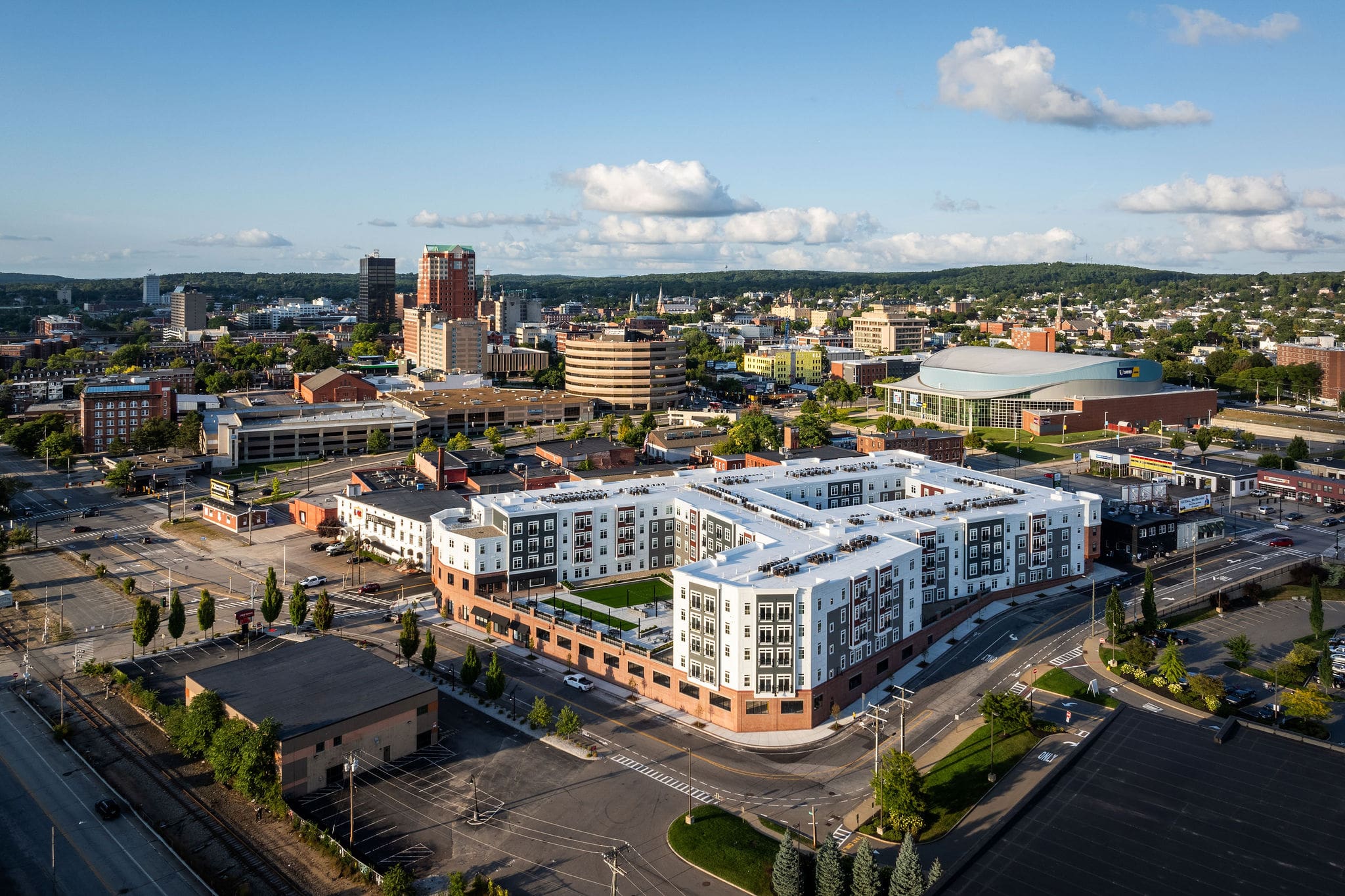
The development occupies a former industrial parcel two blocks from the Manchester, New Hampshire’s historic mill yard and its commercial corridor.
The area is part of the city’s effort to bring new residential density back into the urban core.
Development Context
Manchester’s Gaslight District has been gradually transitioning from historic industrial uses toward mixed residential and commercial development.
For the development team, the opportunity was to introduce Class A housing into a walkable downtown location. The challenge was fitting a 250-unit podium building onto a tight urban parcel while managing grading, existing infrastructure, and code limits.
Early feasibility decisions around structure, grading, and code compliance ultimately set the direction for the project.
“On this project, the early feasibility work really set the direction. Once we understood how the garage, grading, and code strategy could work together, the rest of the building could fall into place.”
– Aubrey Bennett, AIA, senior project architect for 75 Canal
Project Snapshot: 75 Canal
Project: 75 Canal
Location: Manchester, New Hampshire
- 250 units across studios, 1-, 2-, and 3-bedroom units
- 332,400 sf total
- $78M construction cost
- 4-over-1 podium structure
- Ground-floor retail and below-grade parking
- Construction start: Dec 2021
- Phase 1 occupancy: July 2024 / Substantial completion: September 2024
Key Challenges & What Made This Project Work
75 Canal became feasible once a few key issues were resolved early in the process:
- 20-foot grade change across the parcel
- Designed the garage and grading strategy together to minimize soil export on a constrained site
- Existing foundations from the previous warehouse
- Reused warehouse foundations to reduce demolition and structural cost
- Needed to maximize unit density within podium construction limits for a competitive leasing market
- Using code strategically, including firewalls that later supported the construction phasing plan
- Designed units and amenities with lease-up performance in mind
- Coordinating utilities, trash, and service infrastructure on a tight urban site surrounded by rights-of-way
- Solved service infrastructure early, including trash, transformers, and generators on the tight urban site
Project Team:
- Developer: Jones Street Investment Partners
- Architect: Market Square Architects
- Construction Manager: Callahan Construction Managers
- Civil: Fuss + O’Neill
- MEP/FP: Consulting Engineering Services (CES)
- Structural: H+O Structural Engineers
- Interior Design: Arrowstreet
- Photography: Chris Rucinski Photography / Hills 3 Studio
“In the highly competitive world of multifamily development, there is no relationship more important to ownership, or more critical to the success of a project, than the design team. From early concept and permitting, through construction administration and close-out, they are the first to stand with us and the last to leave. It is the partnership that sets the tone for the entire project team. MSA exemplifies design excellence, creativity, technical precision, and problem solving. Those qualities, paired with a deep understanding of our goals are the reasons we choose MSA time and time again as that partner.”
David C. Andronico, Managing Director – Development & Project Management
Early Site Strategy: Foundations, Grading, and Garage Feasibility
Before the architecture could really take shape, the team had to understand how the existing foundations, grade change, and parking podium could work together.
The site came with a few realities that shaped the early design strategy.
- The property still contained existing warehouse foundations
- The site slopes roughly 20 feet
- A tight urban footprint meant all service infrastructure had to be carefully placed
Could we use the existing foundations?
Rather than assuming the previous building’s foundations would be removed, the structural engineer joined design conversations early to study what could remain.
Some portions of the existing foundation were able to be incorporated into the new structural system. This decision saved money in two ways:
- Less demolition and excavation to remove the old foundation
- Less new structure required for the podium and building above
On a project of this size, these early structural decisions protected the budget before the architecture was fully developed.
How to work with the steep grade
Instead of fighting the slope, the garage strategy allowed the structure to work with it, which reduced the amount of soil that had to be removed and exported from the site.
This approach proved useful later. During excavation, the team encountered more contaminated soil than expected (common on former industrial sites). Because the strategy already minimized soil export, the project avoided a major redesign mid-construction.
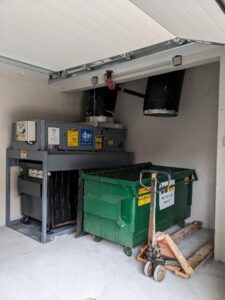
Fitting “back-of-house” pieces into a very full site
Urban multifamily sites need to absorb a surprising number of service elements:
- trash and recycling
- electrical transformers
- emergency generators
- utility access and clearances
At 75 Canal, the building footprint essentially maxes out the site, and the garage (where most of these elements could have been located) daylights at the more prominent side of the building, That meant the usual solution — pushing these elements into the garage edge — wasn’t ideal.
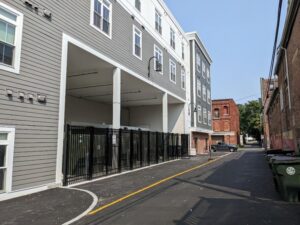
Early coordination with the civil engineer, utilities, and the city led to a different approach: a dedicated utility alcove on the high-grade side of the site, where the building sits at the first-floor level above the garage.
As design progressed, the alcove had to accommodate more than originally planned. A generator and an additional transformer were added, turning the space into something of a coordination puzzle. The team worked through:
- strict utility clearance requirements
- vertical and horizontal equipment spacing
- service access for maintenance and removal
- screening for noise, odor, and visual impact
The final solution became a two-story utility alcove integrated into the building structure.
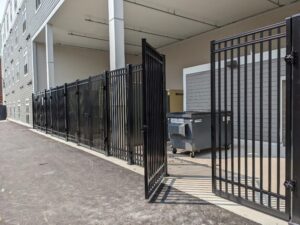
A tall decorative metal fence with multiple gates provides equipment access while maintaining a clean edge along the streetscape.
Trash service is handled through a garage bay with an overhead door, allowing removal without disrupting the public realm.
Like many urban projects, these elements are mostly invisible once the building is occupied. But solving them early was essential to making the rest of the site plan work.
👉 Evaluating an urban multifamily site with existing infrastructure or complicated grading? We often help developers test early feasibility before major design decisions are made. Email us to discuss.
How We Used Building Code Strategy to Achieve Multifamily Density
Reaching the target unit count meant pushing the building close to the limits allowed for this construction type.
Once the site strategy started to make sense (foundations, grading, garage, and utilities) the next question was whether the building itself could reach the density the project needed.
The target unit count pushed the building close to the limits allowed for this construction type and occupancy. Making the numbers work meant using the code strategically and understanding exactly where the boundaries were.
A key outcome was the need for two firewalls.
Because of the building’s size and the 4-over-1 podium construction, the allowable area for this occupancy type was exceeded.
Introducing firewalls allowed the building to be treated as separate structures from a code perspective.That requirement could easily have turned into a coordination headache later. But by resolving them early, we were able to use the firewalls to support the project’s phasing plan.
The building could be constructed and delivered in logical segments without late-stage compliance issues.
It was a quiet win. By nailing down the code strategy early, it reduced risk and made the delivery approach more predictable.
👉 If you’re pushing density limits on a multifamily site, early code strategy can make or break feasibility. We’re always happy to review a site and talk through the options. Get in touch.
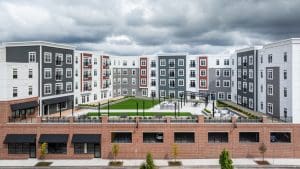
Designing a Podium Garage That Works for the Streetscape
The garage was essential for density, but it also had to work visually from the street.
Below-grade parking made the density feasible. But the garage was visible from the street, and the community didn’t want to look into exposed pipes and systems.
The fix sounds simple: add a hard ceiling to conceal plumbing and present a finished condition.
The challenge was that “simple” choices like that become expensive if they’re handled late.
So, the team coordinated pipe routing early, including identifying penetration locations through structural beams in advance.
That reduced field conflicts and helped keep the garage clean visually, which helped gain neighborhood support and approvals.
Exterior Design That Fits the Historic Gaslight District
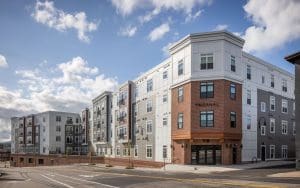
The planning board wanted the building to feel consistent with the district’s historic fabric, but the budget could not support a full masonry building.
The planning board pushed for a masonry feel consistent with nearby historic buildings. Full brick would have been too expensive, so the exterior strategy put material selections where they count:
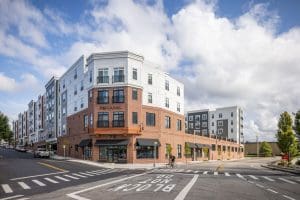
- Brick at the base, with brick carried higher at the main entry to mark the arrival
- Fiber cement siding above as a cost-effective upper-level material
- District-required “gaslight” lighting mounted to the building met standards while controlling costs
Other details nod to the area’s mill-era visual language without turning the building into a replica, such as the “bellied” metal fencing at the deck level that echoes the shape of historic window guards found on nearby buildings. This kind of design choice helps the building feel like it belongs in its context.
Unit Planning: Views, Daylight, and Layout Efficiency
With 250 apartments in one building, efficiency mattered, but the units also had to compete on tour.
The building includes 28 unit types, shaped by the site geometry and the unit mix required through approvals.
The goal was efficiency that still feels livable and competitive on tour.

Units are oriented to maximize views toward the Merrimack River and the surrounding city. Large windows and high ceilings bring daylight deep into the apartments and help the project read as “Class A”.
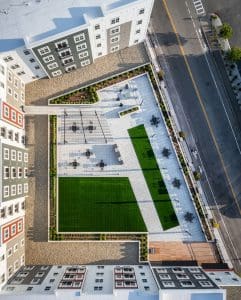
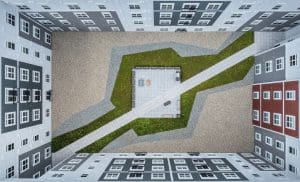
The courtyard strategy also supports tenant experience. One courtyard is set up for social use, while the other is designed to be quietly restorative, including a stone wave pattern referencing the river.
Amenities Designed to Compete in the Lease-Up Market
The amenity program needed to support lease-up in a market where multiple new communities were opening at the same time.
The project’s amenity package is extensive, and is anchored by intentional spaces that provide meaningful appeal and value for tenants.
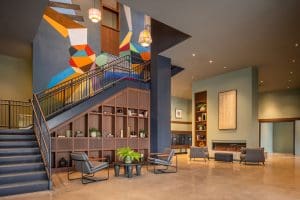
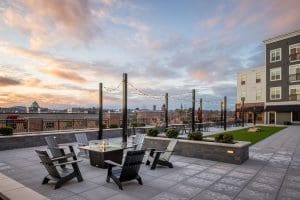
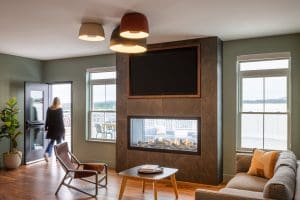
The first impression at the entry lobby is stunning. An open stair connection with 17-foot ceiling heights floods the leasing offices and amenity spaces with daylight and volume. A double-sided fireplace offers an elegant, cozy place to wait. Upstairs, the roof deck and event space feature a see-through fireplace and outdoor views.
Other amenities include a fitness center, club room, co-working space, pet spa, bike storage, and two outdoor courtyards with a fire pit and cornhole. Ground-floor retail brings activity to the street and supports walkability near daily needs, including an adjacent grocery store.
Coordination Between Owner, Architect, and Contractor
On a podium building like this, steady communication between the design team and builder is what keeps the project moving.
Projects like this depend on tight coordination.
A 250-unit podium building on a constrained urban site means a lot of moving parts: structural sequencing, MEP routing through the podium, tight utility coordination, and phasing the building so it can be delivered in stages.
The design and construction teams spent a significant amount of time resolving these issues early and keeping communication open once construction started. That meant regular coordination between the architect, contractor, owner, engineers, and city departments.
During construction, the team maintained ongoing dialogue with Manchester’s Building, Public Works, Fire, and Water departments, along with nearby businesses and residents. Site walks and working meetings helped address concerns quickly and allowed the project team to flag potential issues before they became delays.
That level of coordination helped keep the project moving through a complex build.
The phased delivery strategy allowed the first portion of the building, including 130 apartments, amenities, and model units, to open in July 2024, with the remainder of construction reaching substantial completion in September 2024.
From the contractor’s perspective, that responsiveness from the design team was a key factor in keeping the project on track:
“MSA understands the importance of keeping an open line of communication for real-time collaboration between the design team, builder, and developer. They have been a major factor in the success of the job to date, providing clear and concise answers to keep the work progressing.”
— Patrick Callahan, President, Callahan Construction
Carrying the site’s history forward without turning it into a theme
The previous building on the site left behind materials and stories that were important to the neighborhood.
Before 75 Canal, the site included a building locally known as The Varick. The property had a layered past, including periods of industrial use and evidence of a sawmill chapter.
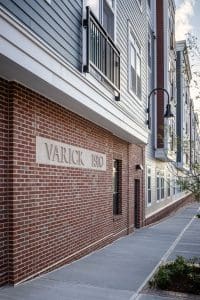
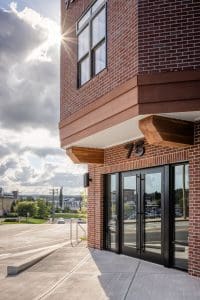
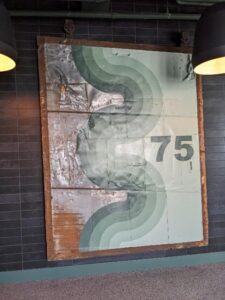
We didn’t want to romanticize the history, but it was important to the community to acknowledge it in a way that felt honest.
The team salvaged a plaster “The Varick” sign and incorporated it into the project as an homage. Salvaged beams and columns from the original warehouse building were reused as reclaimed wood overhangs and corbels at both the main entrance and the residents’ secondary entrance. Columns were also reused for furniture pieces in the amenity spaces, mill-sliding fire doors were reclaimed and artistically painted and hung in various locations within the building, and original masonry ties and fire bells were cleaned and placed on shelving as decorative pieces throughout the amenity spaces.
These elements help connect the new building to what came before, especially in a district where identity is part of what makes reinvestment stick.
After delivery: leasing performance and third-party recognition
From an outcome standpoint, the 75 Canal project delivered.
- 250 new multifamily units on a tight urban infill site
- Street-level retail that activates the corridor
- Below-grade parking that supports density while protecting the public realm
- A full amenity package ready to compete in a crowded market
Lease-up performance is a big part of success. In May 2025, a Jones Street leader shared that the property reached 50% occupancy in a market heavy with competing lease-ups, calling out the strength of the product on tours.
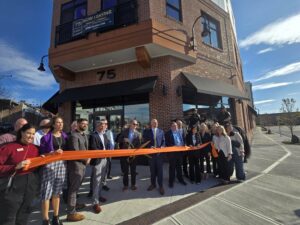
This project also received two awards recognizing execution and teamwork:
- Associated Builders & Contractors (NH/VT), 2025 Excellence in Construction Awards, Merit Award, Commercial Over $10 Million
- Associated General Contractors (NH), 2025 Achievements in Construction Gold Awards, Best in Building
These awards aren’t the point of the story, but they recognize that the coordination and delivery approach worked.
Lessons from Delivering this 250-Unit Urban Infill Multifamily
Looking back, a handful of early decisions set the direction for the entire project.
Urban infill multifamily projects rarely hinge on a single design move. They work when a few critical decisions line up early and stay aligned through construction.
On 75 Canal, several of those decisions set the direction for the rest of the project:
- Treating the site, grading, and garage strategy as early feasibility drivers, not just design problems
- Resolving code limits and firewall locations early, allowing construction phasing to work with the building rather than against it
- Making targeted streetscape decisions that fit the Gaslight District while keeping the exterior budget in check
- Designing unit layouts and amenities with leasing performance in mind, because the market ultimately decides whether the building succeeds
Those choices allowed the project to deliver 250 apartments on a tight urban infill site while remaining aligned with the development strategy behind it.
Projects like this only work when design decisions stay connected to feasibility and delivery. At 75 Canal, that alignment carried the project from early concept through lease-up.
👉 If you’re evaluating an urban infill multifamily opportunity, we’re always open to discussing feasibility, design strategy, or lessons learned from projects like this. Get in touch.